|
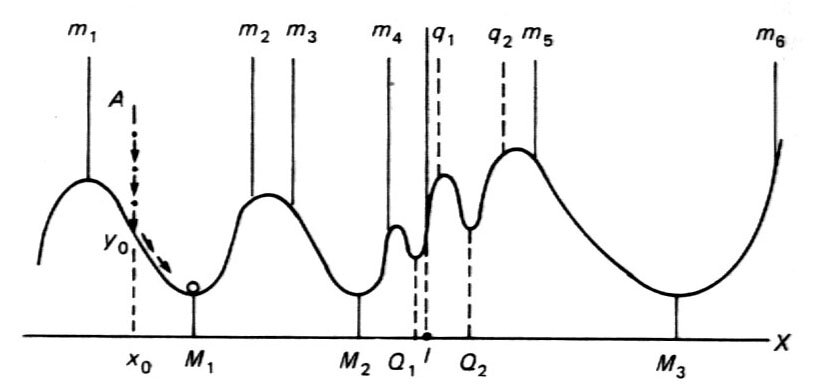
(for example Hopfield’s networks, small simplified simulations of biological neuron networks) consider an ‘energetic landscape’, made up of hills and valleys, within which the ‘mental state’ of the network rolls around like a marble, subject on the one hand to the effect of gravity, which tends to keep it trapped at the valley bottom, and on the other to the action of a kind of ‘thermal noise’, which tends to toss and jolt it out of the valleys.
And it would seem that, above and beyond the metaphor, this is also how our brain works: at any given moment in our lives we find ourselves wrapped in overlaid cognitive domains, as if we were ‘trapped’ within a certain county of our mental territory. The counties correspond to what we could suitably call “Sub-Personalities”, or aggregations of many cognitive domains of different types (Gurdjieff’s ‘momentary mes’, the wards and towns of the CS region). Every situation, every meeting, every circumstance we are involved in ‘activates’ within us a different sub-personality: the marble rolls mechanically into another valley and we are flung into another portion of our mental space, where we will be stuck until a new stimulus, or perhaps the ‘background noise’, here represented by the chemistry of emotions, throws us out.
Thus today we see, in a strictly scientific (if not entirely orthodox) context, the outline of the same psychological picture as that of the ancient system revealed by Gurdjieff, who had instinctively sensed it a long time ago: our conscious mind is similar to a stage where several actors, our sub-personalities, are busy, fighting to take over the scene. In fact, only one actor at a time can act out their part: however, their entry on stage is almost always accidental or mechanically induced by context (the audience, the ‘fight’ behind the scenes). The main thing, above all, is that in normal conditions there is no director overseeing the play (perhaps a better definition would be tragedy) being staged.
The sub-personalities automatically replace each other on the stage of our consciousness, activated by what the neurosciences call ‘structural coupling’ with the external environment: an apparently random process, which is actually pre-determined, that each time decides the prevalence of one group or another of cognitive domains in resonance with external stimuli (Gurdjieff’s influences A, B and C).
As Ouspensky states: “You can say that personalities consist of different ‘mes’. Anyone can find different personalities within himself, and real self-study begins with studying these personalities, because we cannot study the ‘mes’: there are too many. Whereas it is easier with personalities, in that each personality or group of ‘mes’ signifies some special inclination or tendency, or at times some aversion”.
If we substitute the term ‘personality’ with ‘sub-personality’ and ‘me’ with ‘cognitive domain’, we see the thinking of Gurdjieff (or Ouspensky) marrying cognitive neurosciences: each of our sub-personalities will thus be seen to be characterised by the prevalence within it of certain categories of cognitive, intellectual, senso-motory, emotional or instinctive domains, which will at any given time be active or passive, dominated by the left or right hemisphere. In turn, the predominance of certain types of sub-personality in a given individual will allow us to catalogue him or her – according to Gurdjieff – as type 1, type 2 or type 3.
|
|
Perhaps we are talking about types 4, 5, 6 and 7. Perhaps we are talking about the ‘internal circle’ of humanity.
Certainly we are talking about an as yet unexplored area of our mind, about regions where neurosciences are just starting to venture, but where there is a strong sensation that, like in an enormous historical spiral, the most advanced points of current scientific research are just rediscovering ancient truths about ourselves and the nature of our conscious mind.
Alessandro Pluchino
June 2002
|