|
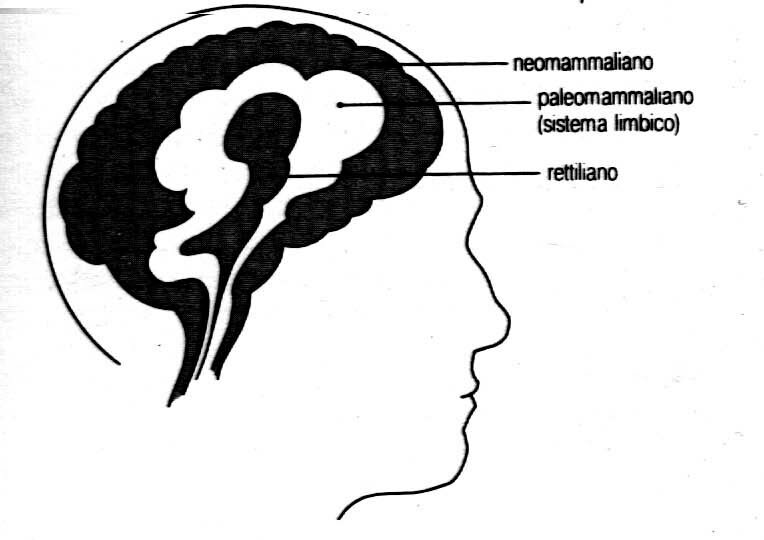
“the mother of invention and the father of abstract thought”, as MacLean emphasises. It is the seat of symbolic language: it reasons, plans, worries, writes books and sonnets, creates, invents and composes. But it is also through its centres for vision, hearing, taste, smell and physical sensations that we relate to the outside world and interact with it through motor-sensory schemes.
The neurone networks of the neo-cortex can thus be said on the one hand to constitute the neuro-physiological equivalent of Gurdjieff’s ‘intellectual centre’, and on the other hand, to represent a fair part of our ‘motory centre’, since they control our motor responses to sensorial stimuli.
The relationship with the ‘emotional centre’ should however be sought in the ‘paleo-mammalian brain’, which is part of the limbic system, the headquarters of our emotions. If we limit ourselves to the level of mice, rabbits and cats, the limbic system is anchored to survival, to self preservation and preservation of the species, and its behaviour rotates around the ‘four Fs’: feeling, fighting, fleeing and fucking. “One of the peculiar features of the emotions,” observes MacLean, practically echoing the words of Gurdjieff, “is that they are never neutral: emotions are always pleasant or unpleasant,” positive or negative.
And that’s not all. But, as the psychologist Daniel Goleman strongly maintains (again calling to mind the words of Gurdjieff), they are also much quicker than rationality: through the amygdala, a kind of emergency switchboard in the limbic system, the emotional neuronal routes can often by-pass the neo-cortex, committing what amounts to ‘emotional kidnap’ against the rational brain. These kidnaps are then modulated or at times inhibited, in superior mammals, by the pre-frontal lobes of the neo-cortex, which, on slower time-scales, succeed in regaining control of the situation. Whereas a large proportion of the mental life of birds, fish and reptiles rotates around them, in that their survival depends on the constant analysis of the environment to locate predators or potential prey.
And it is from these same reptiles that we humans inherited the third component of our ‘trinity’ brain: the so-called ‘reptilian brain’, located in the encephalic stem and surrounding structures, the site of those same ‘archaic behavioural programmes’ and automatic senso-motory reactions that stimulate snakes and lizards. “Stiff, obsessive, forced, ritualistic and paranoid,” as MacLean defines it, “it is full of ancestral experiences and memories.” Being represented so persistently in the brain’s circuit schemes, it is condemned to repeat the past continuously. The ancient reptilian brain does not profit greatly from the experience. It is thus an excellent candidate to represent Gurdjieff’s ‘instinctive centre’ (and to some extent also the ‘sexual’ one, which is of particular importance in the gurdjieffian system).
However, to complete the neuro-scientific picture, we must add to this ‘vertical’ subdivision of the single and triune brain a ‘horizontal’ subdivision, into the two hemispheres - left and right, interconnected through the corpus callosum.
As is well known, the left hemisphere is active, constructive, algorithmic, gradual and logical. It benefits from limited exemplification and from trial and error procedures. It is capable of learning by applying rules. Again, the left hemisphere is usually the seat of language and thus of rational thought: it is linear, concentrated and analytic. It discriminates, measures and categorises: it is thus, by its very nature, fragmentary. But also expansive, competitive and aggressive.
The right hemisphere, in contrast, tends to prefer synthesis: it is holistic and non-linear, contractive and synthetic, passive and co-operative. It is the seat of intuitive thought, does not seem to learn from exposure to rules and examples, but needs to be exposed to rich, associative structures, which it tends to grasp as a whole. Intuitive knowledge seems, in fact, to be founded on direct, non-intellectual experience of reality, which springs from an open state of consciousness.
In a nutshell, using well-known oriental terminology, we could call the left hemisphere yang, therefore active, positive and masculine (at the basis of rational knowledge and thus of egocentric activity), whilst the right hemisphere is yin, thus passive, negative and feminine (at the basis of intuitive knowledge and thus of ecological activity).
Gurdjieff, too, speaks of a ‘horizontal’ subdivision of the centres into two halves: one ‘positive’ and one ‘negative’. This duality is seen, for example, in the intellectual centre in the form of the yes-no contraposition, i.e. ‘affirmation-negation bipolarity’, and in the instinctive centre in the form of the dual concept ‘pleasure-pain’. And the emotional centre also seems to consist of the two halves represented respectively by pleasant and unpleasant emotions, even if in the ‘Fourth Way’ Ouspensky warns that ‘negative emotions’ work with the help of a separate ‘artificial centre’, which fuels them above all by ‘imitation’.
Ouspensky himself then emphasises how either half of each centre is in turn divided into three parts, in a kind of overall ‘fractal’ or ‘holographic’ structure where all can be found in the part, and the part in all.
|